The roof, the walls and the organ
Inside Matthias Church
What to look at in Matthias Church: the diamond-pattern roof, Schulek's painted Gothic interior, the royal tomb and the five-manual organ above the west door.
Book a seat on Castle Hill ↗Quick answer
Matthias Church is known for its coloured roof, a diamond pattern of glazed tiles that includes Zsolnay ceramics, and for its painted interior, designed in the late 19th century by Frigyes Schulek with the painters Bertalan Székely and Károly Lotz. Inside you can find a royal tomb, a Loreto chapel and a five-manual organ.
The roof
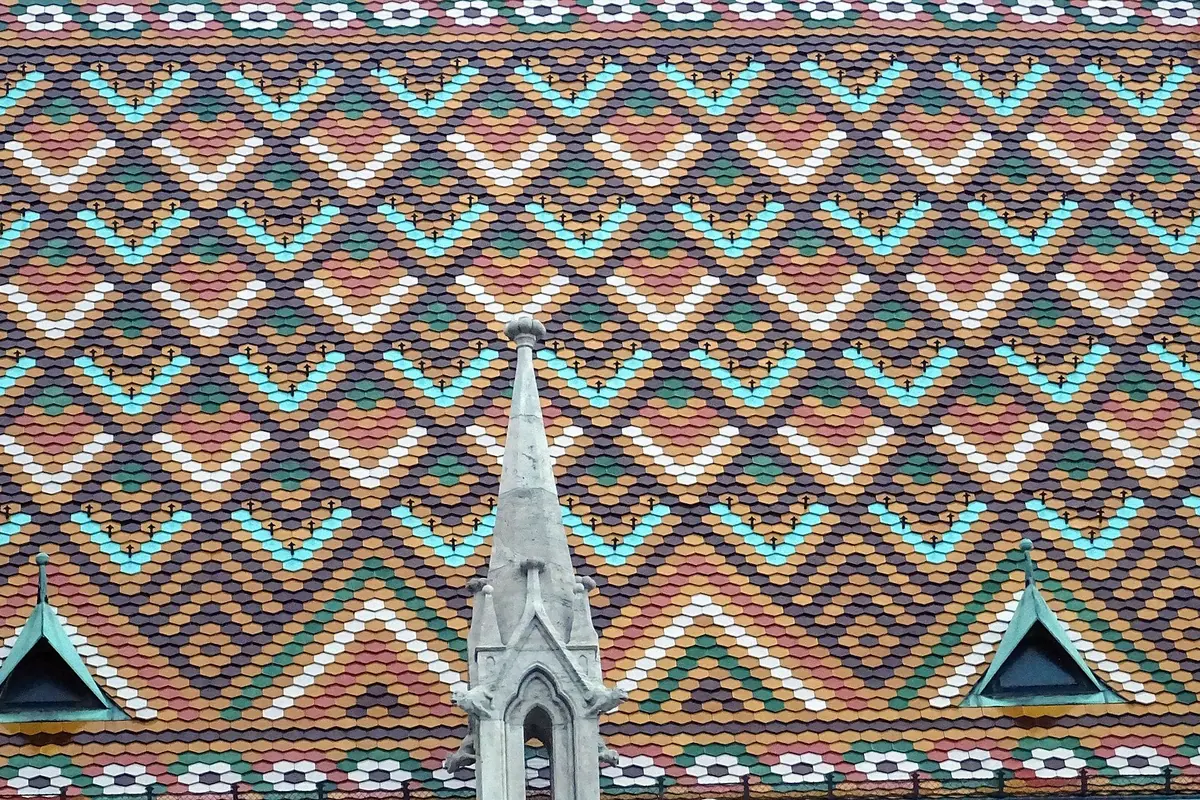
The roof is the church's signature: bands of glazed tiles laid in a diamond pattern of red, green, turquoise and cream. Wikipedia credits Schulek with adding the diamond-pattern roof tiles during his rebuilding. Wikipedia's article on Zsolnay shows the roof of Matthias Church in its eosin section and lists the church among the buildings that use Zsolnay ceramics, a firm founded in Pécs in 1853. From the square the roof reads as a single coloured field, and up close each tile has its own glaze. The pattern changes from one roof plane to the next, so it is worth walking round the church to see the apse end as well.
The painted walls
Inside, patterned colour covers almost every surface. Wikipedia says Székely and Lotz directed the interior decoration with Schulek, using the remains of the medieval wall paintings, and painted the figurative murals themselves. The result is a Gothic hall dressed in 19th-century decoration, so the nave reads as colour first and stone second. Look up at the vaults and across the piers: the patterns repeat in bands, and the medieval bones of the building show through them.
Glass and altar
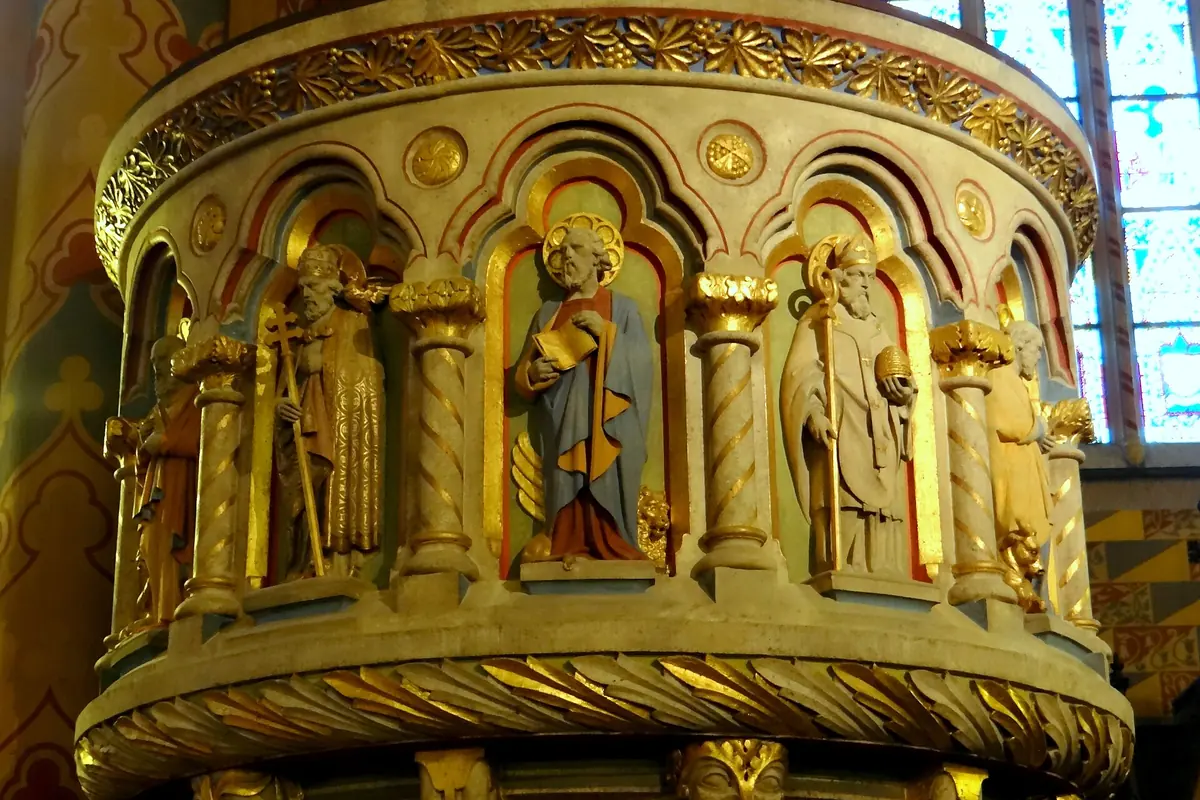
Lotz and Székely also made the designs for the stained-glass windows, which were executed by Ede Kratzmann, according to Wikipedia. Lotz painted altarpieces as well. The high altar frames a painting of the Virgin within a gilded Gothic surround, between windows of coloured glass, and the pulpit is carved with figures of saints under small arches. In the evening, with the lamps on, the gilding carries much of the light in the room.
A royal tomb
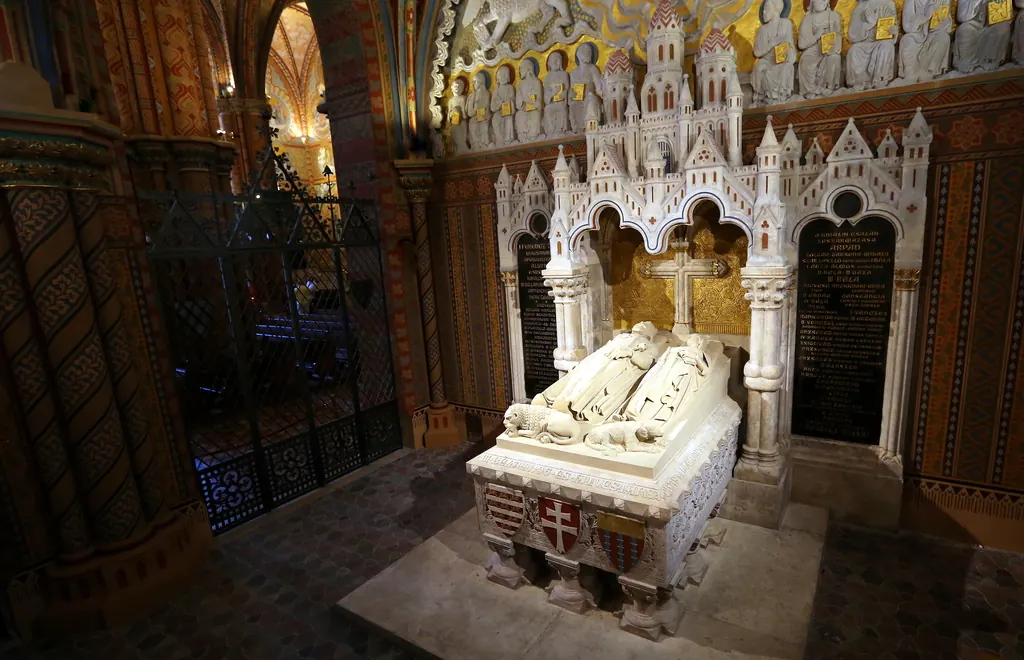
In 1898 the remains of Béla III of Hungary and his first wife, Agnes of Antioch, found their final burial place in the chapel of the northern nave. Their white stone tomb is one of the church's quietest corners, and a reminder that the building's royal history reaches back to the Middle Ages, long before the coronations of 1867 and 1916. It sits in a dark side chapel, so it rewards a slow look rather than a quick pass. The remains arrived in 1898, in the same decades as the painted walls around them, so the tomb belongs as much to the church's 19th-century rebuilding as to the Middle Ages.
The Loreto chapel and the museum
Beneath the southern tower, the Loreto Chapel is of medieval origin and preserves a Madonna statue. The church also houses an Ecclesiastical Art Museum, which begins in the medieval crypt and leads up to a chapel on the upper level. These parts belong to the church's daytime visiting arrangements, which the concert ticket does not cover, so check the church's own website if you want to see them.
The organ
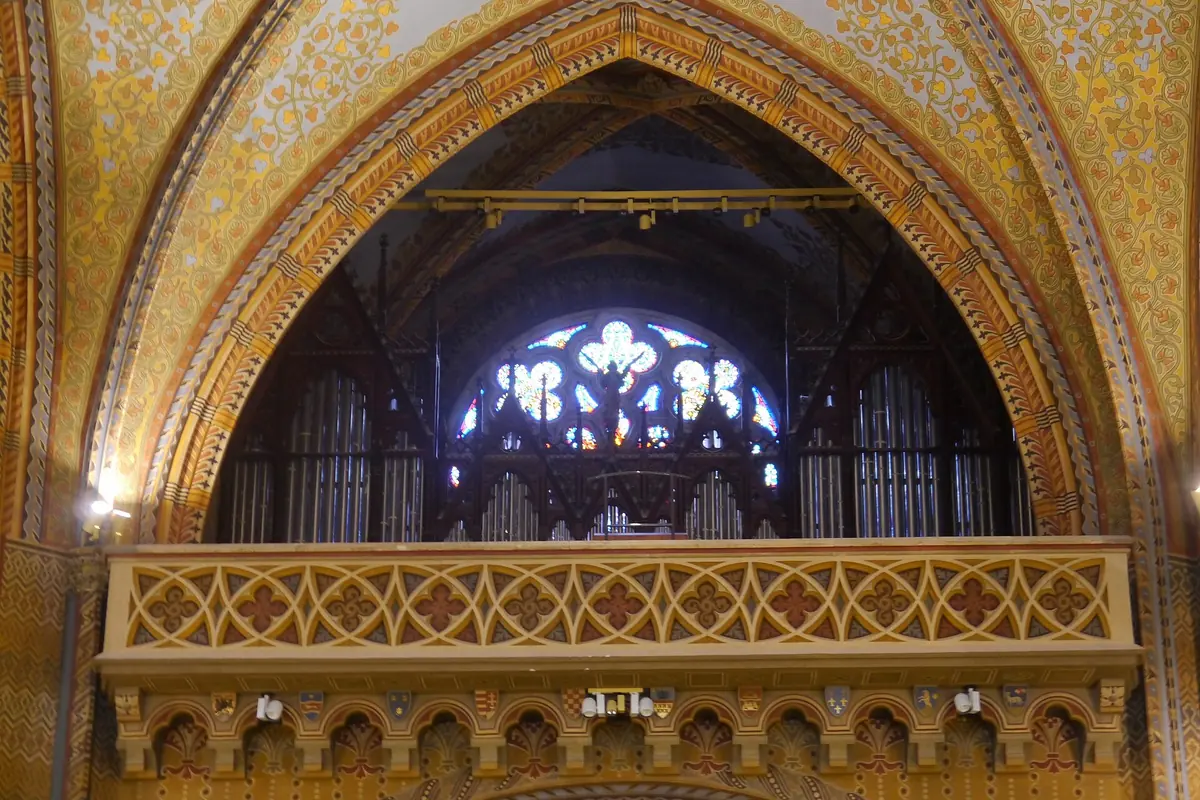
Rieger of Jägerndorf built an organ here in 1909 to plans by Viktor Sugár, a late-romantic instrument with four manuals. It was enlarged in 1931, heavily damaged in the siege of 1944 and rebuilt by Rieger-Kloss, opening in January 1984 with five manuals. The church also has a smaller two-manual organ in the chapel. The string concert on this site's ticket does not feature the organ, though the instrument is part of the church's music, and the church's organ page gives the full story of the instrument.
Frequently asked questions
Who painted the interior?
Bertalan Székely and Károly Lotz directed the decoration with Frigyes Schulek and painted the figurative murals themselves.
Is the roof made of Zsolnay tiles?
Zsolnay ceramics are used on the roof, according to Wikipedia's article on the firm, which names Matthias Church.
Who is buried in the church?
Béla III of Hungary and his first wife, Agnes of Antioch, whose remains were buried in the northern nave chapel in 1898.
Sources